
Buying GuidePet Product Guide
2026年5月30日
How to Identify High-Quality Dog Harnesses (Wholesale Buyer’s Guide)
A 20-year pet manufacturer's guide on identifying stable quality in dog harnesses during bulk production. Learn why repeat orders deform and how we control it.
How to Identify High-Quality Dog Harnesses, Collars, and Leashes (Wholesale Buyer’s Guide)
Most wholesalers, distributors and brand owners already know the theory: better quality protects margins and lowers return rates. The difficult part is keeping that quality stable once production actually scales up.
We’ve spent over 20 years producing pet harnesses, collars, and leashes for overseas brands. One thing repeats again and again: the sample looks perfect, then the second or third bulk shipment starts feeling slightly different. Usually this doesn’t show up during visual inspection. It starts showing up later in customer reviews.
Here’s what we usually pay attention to during production.
1. Fabric Quality: The Core of a Dog Harness
Sandwich mesh, neoprene, and Oxford fabrics are standard materials in this industry. But GSM alone doesn’t tell you very much.
We’ve seen plenty of harnesses that feel solid during sampling, then slowly lose shape after a few weeks of pulling force.
Some common issues we observe:
- 380g/m² mesh can still stretch permanently if the yarn density is loose.
- Neoprene sometimes softens and develops permanent creases after long periods of compression during warehouse storage.
- Edge binding may look full at first but flatten after repeated washing.
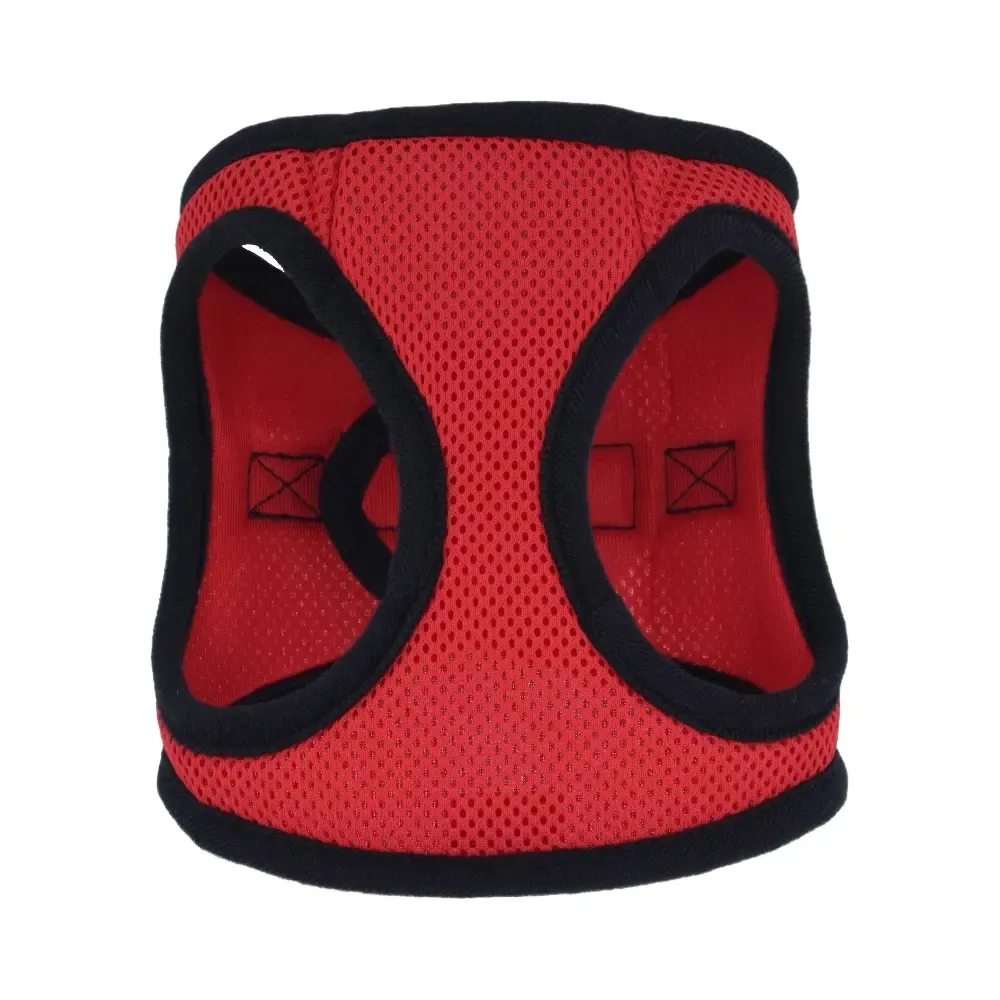
For our mesh harnesses, we use denser warp-knitted 3D sandwich mesh from Changshu suppliers running imported German machines. We've seen that the middle layer rebounds better under pulling force and keeps airflow more stable. Dogs with longer fur also get less hair trapped inside the mesh structure.
Color bleeding is another issue buyers often underestimate, especially for white or light-colored dogs. Once the harness gets wet, cheaper dyes start transferring onto fur very quickly, and that's usually when the first 1-star reviews hit your store. We keep color fastness at Grade 4 or above under water, rubbing, and sweat testing conditions.
More buyers also ask for OEKO-TEX® Standard 100 materials now, especially for skin-sensitive dogs. That removes risks like formaldehyde residue, azo dyes, and heavy metal processing chemicals.
[ What We Observe During Bulk Runs - Comparison Table ]
Feature | Stable Production (Our Standard) | Lower-Cost Production |
Fabric Structure | Dense 3D mesh, holds shape under pulling | Flimsy 280g/m² mesh, deforms over time |
Color Fastness | Grade 4–5, minimal fading or bleeding | Grade 3–3.5, color transfer appears when wet |
Safety & Testing | OEKO-TEX Standard 100 certified | No testing / unknown chemical residues |
Comfort | Smooth surface, edges stay rounded | Rough, stiff, flattens and causes chafing |
Even with proper GSM, mesh harnesses are still meant more for daily walking than heavy pulling. We also see small differences between batches depending on weaving tension and dye lot conditions.
[Insert Image Here: Close-up view of high-density 3D mesh dog harness material showing the inner structure. ALT Text: high-density 3D sandwich mesh dog harness material]
2. Hardware Quality: Safety You Can’t Ignore
Most metal hardware passes basic tensile testing. The bigger issue is how stable the structure stays during long production runs.
[ What We Check on the Floor - Tensile Standards ]
Hardware Type | Approx. Breaking Force |
20mm / 25mm Zinc Alloy Buckle | ~250 kgf |
15mm / 20mm / 25mm Aluminium Alloy Buckle | ~150 / 350 / 550 kgf |
20mm / 25mm Zinc Alloy D-ring | ~250 kgf |
20mm / 25mm Aluminium Alloy D-ring | ~350 kgf |
What matters more than alloy type:
- Wall thickness consistency
- Smooth edges
- Stable coating adhesion
- ROHS / REACH compliance
Zinc alloy is heavier but works well for daily-use products. In lower-cost production, unstable casting pressure sometimes creates internal air gaps around thinner sections. Those problems usually don’t show up immediately during regular QC. They show up later under repeated stress when a dog suddenly lunges on the street.
Aluminium alloy feels lighter in hand and generally performs better in pulling tests, which is why many tactical products use it.
[Insert Image Here: Dog harness metal buckle tensile testing. ALT Text: dog harness buckle tensile strength testing]
3. Plastic Buckles: Small Part, Big Risk
A harness is only as strong as its weakest point. Plastic buckles usually pass initial QC without problems. The real issues tend to appear later during shipping, storage, or repeated use.
Typical failure situations we hear from buyer complaints:
- Buckles turning brittle and snapping in sub-zero winter conditions.
- Locking force weakening after repeated opening and closing.
[ Internal Pull Test Standards ]
Buckle Size | Approx. Breaking Force |
15mm Buckle | >= 102 kgf |
20mm Buckle | >= 119 kgf |
25mm Buckle | >= 189 kgf |
38mm Buckle | >= 210 kgf |
Plastic hardware is lighter and more cost-effective, but molding temperature still affects hardness consistency between batches. We mainly use engineering-grade POM materials for better long-term stability under temperature changes.
[Insert Image Here: Tensile strength test report for 20mm dog harness buckle. ALT Text: dog harness plastic buckle tensile test report]
4. Stitching and Craftsmanship
Samples almost always look clean. Bulk production is where differences begin appearing.
What we focus on:
- Straight and consistent stitching lines
- Reinforced stress points (Bartack / X-box stitching)
- Clean finishing without loose threads or sharp melted edges
In some batches, machine tension drifts during long runs. Different operators sew slightly differently as well. To reduce variation, we lock bobbin and thread tension settings per shift so later production stays close to the original sample.
5. How to Choose the Right Supplier in China
Price is easy to compare. Production consistency is much harder.
A reliable OEM/ODM supplier should be able to provide:
- Stable quality during long production runs
- Transparent testing data for fabrics and hardware
- Experience with US / EU / AU compliance requirements
- Predictable lead times and communication
A serious factory should also explain where materials behave differently instead of automatically choosing the cheapest option. Most sourcing problems don’t happen during sampling. They start appearing after repeat orders.
Request a Wholesale Quote or Custom Sample
If you are upgrading your pet product line or dealing with high return rates caused by unstable quality, we can support your OEM/ODM project with stable production control and transparent testing data.
At Idopets, we focus on long-term production consistency rather than short-term sampling results.
- MOQ: Flexible for wholesale and brand orders
- Customization: Logo, color, size, structural adjustments, and packaging (including Amazon FNSKU compliance)
- Lead Time: Fast sampling and stable bulk production cycles
Contact us for factory-direct pricing:
Email: tina@sinoido.com.cn
WhatsApp: +86 19557582885